miércoles, 1 de noviembre de 2017

Ver versión Online | Enviar a un amigo
facebooktwittergooglemaswhatsapp
compania
NEWSLETTER NOVIEMBRE-DICIEMBRE
Centro Cultural Coreano

Pianista Dong Hyek Lim en el CCK
Corea_Más_Cerca_Octubre
Fecha: jueves 9 de noviembre, 20 hs
Lugar: Sala Sinfónica del CCK (Sarmiento 141, CABA)

Dong Hyek Lim, cuya mentora es la reconocida Martha Argerich, se presentará en Argentina con un concierto especial de piano por los Juegos Olímpicos de Invierno en PyeongChang 2018. Invitado por el Centro Cultural Coreano y el CCK, el pianista Dong HyeLim realizará su primer concierto en Argentina con un programa que busca cautivar al público local. El repertorio seleccionado es de Franz Schubert e incluye Sonata para piano N. 20 en La mayor D. 959 y Sonata para piano en Si bemol menor D. 960.

Las entradas son gratuitas y pueden reservarse a partir del martes 7 de noviembre a través de www.cck.gob.ar/reservas o directamente en las boleterías del CCK

Organiza: Centro Cultural Kirchner, Centro Cultural Coreano
La Noche de los Museos en el CCC
K-beauty con Jin Yi
Fecha: sábado 4 de noviembre, de 20 a 03 hs
Lugar: Centro Cultural Coreano (Coronel Díaz 2884, CABA)

El Centro Cultural Coreano abrirá sus puertas durante La Noche de los Museos para ofrecer espectáculos folclóricos coreanos como UHEE Nori (artes escénicas tradicionales), HAN Yongseop & Nuripae (música tradicional coreana) y CHOI Yung Kang (danza folclórica coreana). La sala multimedia se convertirá en un Boliche K-Pop, y en la biblioteca se ofrecerán dos charlas sobre literatura coreana a cargo de Miguel Balaguer (de Editorial Bajo la Luna) y JO Mi-hee (poeta coreana).

La entrada es libre y gratuita.
Buenos Aires Celebra Corea
Corea_Más_Cerca_Octubre

Fecha: domingo 5 de noviembre, de 10 a 20 hs
Lugar: Av. Avellaneda entre Nazca y Campana (CABA)

Buenos Aires se prepara para una nueva edición del evento más importante de la comunidad coreana en nuestro país. Habrá actividades, shows increíbles y numerosos stands de comida. ¡Te esperamos con toda tu familia!

Entrada libre y gratuita.
K-Pop en Pantalla
Vení a ver los mejores recitales de K-Pop
en pantalla gigante
IMG_5606
Todos los conciertos se exhibirán en la sala multimedia del Centro Cultural Coreano (Coronel Díaz 2884), en pantalla gigante y con sonido envolvente.

1º Concierto “Blockbuster”
Video con la primera performance en vivo del grupo de pop coreano Block B, un recital increíble en el Olympic Park Olympic Hall.
Sábado 11 de noviembre a las 15 hs

SM Town – The Stage
Un increíble detrás de escena con miembros de Super Junior, Girls' Generation, EXO, Shinee y más mientras se preparan para el "SMTOWN Live World Tour IV"
Sábado 16 de diciembre a las 16 hs

La entrada es libre y gratuita.
Exhibiciones
Muestra: rumbo a los Juegos Olímpicos 2018
poster,_Barrileteada,_ccc(1mb)
Fecha: noviembre (fecha a confirmar)
Lugar: Centro Cultural Coreano (Coronel Díaz 2884)

El Comité Olímpico Argentino y el Centro Cultural Coreano organizan una muestra especial por los Juegos Olímpicos de Invierno de Pyeonchang 2018 en Corea. Fotos de atletas, réplicas de antorchas olímpicas, mascotas oficiales y muchas otras piezas podrán ser vistas al público por primera vez. El cóctel de inauguración es abierto al público.

Organizan: Comité Olímpico Argentino, Centro Cultural Coreano

Ciclo de cine

...

A critical US ally is feeling left out, and Trump has a chance to fix things

  • President Donald Trump should follow four key principles when he visits Seoul next week, experts said
  • The bilateral relationship has been on shaky ground in recent months as some South Koreans feel like their country has been sidelined during the North Korea crisis
The U.S.-South Korea relationship has been on shaky footing as both nations espouse different views on reigning in a belligerent Pyongyang. At a time of heightened alarm on the Korean Peninsula, President Donald Trump has a chance to strengthen the 67 year-old military alliance when he visits Seoul in a week.
His trip will be especially vital in rectifying the sense of exclusion felt by both officials and civilians in Asia's fourth-largest economy.
Many South Koreans feel their country has been sidelined during the North Korea crisis — an idea that domestic media has dubbed "Korean passing." News outlets regularly point out how Trump's engagement with Seoul on the issue pales in comparison to his relationship with Tokyo, reflected by the frequency and intensity of phone conversations with leaders of both countries.
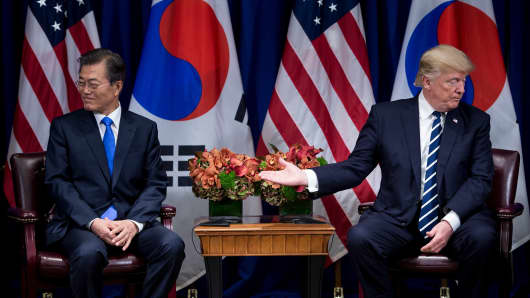
President Donald Trump gestures to South Korean President Moon Jae-in during the 72nd United Nations General Assembly on September 21, 2017.
BRENDAN SMIALOWSKI/AFP/Getty Images
President Donald Trump gestures to South Korean President Moon Jae-in during the 72nd United Nations General Assembly on September 21, 2017.
Japanese Prime Minister Shinzo Abe shares Trump's hard-line stanceon tackling Pyongyang, while South Korean President Moon Jae-in has a toned-down approach of engagement.
"Korea passing is a genuine concern," said Robert Kelly, associate professor at Pusan National University, noting that Moon's critics often use it against him. "It is clearly the case that Trump and his flamboyant style have taken over the North Korea debate in 2017 and pushed Seoul aside. I would be worried if I were the South Koreans."
Some in South Korea even fear that a major provocation from their northern neighbor could result in Washington staging unilateral military operations. In response to Trump's "fire and fury" threat against dictator Kim Jong Un, Moon warned in August that "no one should be allowed to decide on a military action on the Korean Peninsula without South Korean agreement."
Further exacerbating the matter is the fact that the White House still hasn't nominated an ambassador to South Korea, a position that's been vacant since Trump took office in January.
To strengthen the bilateral alliance, there are four key principles the U.S. leader must follow when he meets Moon on Nov. 7, experts said.

Present a united front

Trump "must convincingly reassure President Moon and the South Korean public that the United States and South Korea are in lockstep on the North Korea issue," Jung H. Pak, senior fellow at the Brookings Institution's Center for East Asia Policy Studies, said in a recent note. "There must be no daylight between the two leaders."
In September, Trump rebuked Moon's policy of outreach with Pyongyang.
"From the standpoint of both alliance management and of showing the North Korean regime that they cannot drive a wedge between the two allies, it is essential to present a united front," said Daniel Sneider, visiting scholar at Stanford University's Walter H. Shorenstein Asia-Pacific Research Center.
Seoul and Washington may share fundamental differences on strategies, but the two are on the same page when it comes to the underlying goals of denuclearization and standing up to Kim's threats, Sneider noted.

Place Tokyo and Seoul on equal footing

Trump's Asia tour will see him spend two days each in JapanVietnamand the Philippines but only one day in South Korea. That could further heighten the sentiment of neglect in Seoul. "Koreans tend to get exercised about these things, particularly the Korean media," Sneider said.
White House officials should ensure parity in Trump's trips, Pak said: "That means don't spend one day in Seoul if you're going to spend two days in Tokyo."
But Kelly of Pusan National University warned against reading too much into the situation, calling it more of a scheduling issue than anything else.

Stress a combined defense network

South Korea is a non-nuclear state, but talk of nuclear armament has been high amid the North's increased missile launches.
Last month, South Korean Defense Minister Song Young-moo and U.S. Secretary of Defense James Mattis discussed the prospect of returning American tactical nuclear weapons to South Korean soil. Washington had stationed weapons there in 1958 but withdrew them in 1991.
Meanwhile, a recent Gallup poll indicated nearly 60 percent of South Koreans supported national development of nuclear weapons, local media reported.
Both scenarios are seen as dangerous and high risk so Trump may wish to reiterate America's military support.
"As the [recent] visit of Defense Secretary Mattis made clear, it is vital that the U.S. guarantees of extended deterrence be credible and visible," said Sneider, referring to the American policy that it will defend Seoul under all circumstances.
Moon has played down calls for a return of U.S. tactical weapons and independent nuclear capabilities so by highlighting joint defense, Trump will be supporting Moon, said Pak.

Don't bring up the free trade agreement

Trump has threatened to withdraw from the United States–Korea Free Trade Agreement and repeatedly criticized the five year-old pact during Moon's first visit stateside earlier this year.
That "unnecessarily created an appearance of frosty ties, even as the North Korea threat loomed," Pak said. If Trump must bring up the deal in Seoul, "then do so quietly," she continued.
Sneider, on the other hand, said he saw no reason for Trump to take up the issue in any way: "I hope the President does not focus on this."

WATCH:  President Trump will not visit DMZ on Asia trip