domingo, 8 de junio de 2014


Web Bug from http://link.channelnewsasia.com/img/trans.gif
Asia Pacific

jueves, 5 de junio de 2014

The Asia-Pacific Journal: Japan Focus Newsletter
 
Newsletter No. 22. 2014    

June 2, 2014    

New Articles Posted

Quick Links
Home

In This Issue
 
Sarah Bird 
  
Kinjo Shigeaki 

Morita Seiya   

 
Greetings!  
 
We feature two Okinawa-themed articles this week. Sarah Bird's novel, Above the East China Sea, excerpted here, describes the suicide dilemma facing a young Okinawan during the battle, and then pursues the same theme into the ranks of US forces on Okinawa in the present. Her discussion with former Marine Steve Rabson explores themes from the two periods and the making of the novel. The theme of compulsory suicide is the subject of Kinjo Shigeaki's interview on the circumstances in which he and his family were caught when he was a sixteen year old during the Battle of Okinawa in March 1945. Contrasting two forms of discrimination in contemporary Japanese society-Zaitokukai's repeated hate demonstrations directed at Zainichi Koreans and the treatment of women in a recent high profile art exhibit at the Mori Museum, he queries the silence of progressives on issues of gender discrimination.

We invite you to follow APJ on Facebook or Twitter by clicking on the highlighted links above.

Have you used the APJ search engine? The best results may be obtained by going to the left home page and typing in key words such as Okinawa, 3.11, energy, or Vietnam War under Title.

Please try the new pdf feature at the top of each article, particularly if you wish to print it. It can also be copied and pasted into a Word file to adjust type size and font. Let us know if you encounter problems. info.japanfocus@gmail.com.

Thanks to  the generous support of our readers, we succeeded in raising more than $12,000 to fund the Journal for 2014. The Journal will remain free. You can still support the journal at our home page with your 501 (C) tax-deductible gift payable to Paypal or a credit card.


Sarah Bird with Steve Rabson      
Above the East China Sea:
Okinawa During the Battle and Today  

This article provides excerpts from Sarah Bird's newly published novel, Above the East China Sea, together with the author's conversation with Steve Rabson, who served in the military on Okinawa in 1968 en route to becoming a leading translator of Okinawan literature. Bird's novel engages the themes of suicide and death from the 1945 Battle of Okinawa to the present, interweaving the fate of Okinawans and American occupying forces.  
 
Sarah Bird's novel, Above the East China Sea, was published in spring 2014 by Knopf. This is her second novel set in Okinawa, following The Yokota Officers Club, published by Ballantine (2001).


Kinjo Shigeaki interviewed by Michael Bradley
"Banzai!" The Compulsory Mass Suicide of Kerama Islanders in the Battle of Okinawa
Translated by Maehara Naoko  
  
This is an April 2014 interview with 85-year-old Kinjo Shigeaki, a survivor of the compulsory mass suicides which occurred on Tokashiki Island, Okinawa in March 1945. Kinjo details the atrocities he was both subject to, and forced to commit, during the Battle of Okinawa. The author calls on the Japanese government to properly account for this period in Japan's Imperial history.  

Michael Bradley, a former broadcast journalist with BBC Northern Ireland, teaches at Okinawa Christian Junior College. 


Morita Seiya
Taiwan and the Ryukyus (Okinawa) in Asia-Pacific Multilateral Relations - a Long-term Historical Perspective on Territorial Claims and Conflicts
Translated and Introduced by Caroline Norma 

Morita Seiya's timely book, excerpted here, challenges the meaning and limits of Japanese misogynistic cultural products as a form of "hate speech." Contrasting the strong progressive response to the public attack on Zainichi Koreans through repeated Zaitokukai demonstrations in Tokyo with the silence in the wake of of Aida Makoto's 2013 exhibition at the Mori Art Museum in Tokyo, the author confronts public media contexts where women, children, and disabled people are exclusively targeted victims; where the environment is sexualised; and where the context is purportedly one of entertainment, art or culture.

Morita argues that Japan's progressives, including human rights activists and liberals, have been blind to human rights violations against women, or at least do not see anything serious enough to warrant raising voices in protest in such contexts. The author asks why pornography showing human rights violations like rape, enslavement and brutalization produced in numerous films and other media each year are justified as 'freedom of expression.'

Translator Caroline Norma lectures in the School of Global, Urban and Social Studies at RMIT University and is an editorial board member of Women's Studies International Forum. Her book, Japanese comfort women and sexual slavery during the China and Pacific wars, is forthcoming from Bloomsbury in 2015.

Silk Road House

Connie Chin, administrator of the Department of East Asian Languages and Cultures at Stanford, traveled by train across Mongolia and the northern Silk Road last summer. This slide presentation will show some of the highlights, such as staying with nomads in Mongolia, talking with Han, Uyghurs, and Tibetans in northwest China, exploring museums and archaeological sites, and walking the streets of Silk Road cities (modern cities of three million, and remnants of ancient cities baking in the sun). Connie will also share her observations on economic development and the tourist industry in China.

 Connie Chin holds a B.A. from Oberlin College and an M.A. in ancient and medieval history from San Jose State (2012). She is author of "Climate Change and Migrations of People during the Jin Dynasty (Early Medieval China, 13/14, 2008) and "Geography and Social Structure of Monasteries: Cultural Diffusion or Convergent Evolution?" (SJSU Scholar Works, UMI, 2012). She is studying Sogdian language with Drs. Fred Porta and Albert Dien.

 The event will take place at SRH on Sunday June 8, at 1-3pm.

 Silk Road House, 1944 University Ave., Berkeley, CA 94705 (between Milvia & Martin Luther King; enter by side door in passageway under black Zabu Zabu awning); e-mail: silkroadhouse@yahoo.com; website: www.silkroadhouse.org; facebook page: https://www.facebook.com/SilkRoadHouse; tel.: 510-981-0700.

Silk Road House events are sponsored by the Silkroad Foundation.

---Posted by: Alma Kunanabeva <almak@stanford.edu>

Tiananmen

Tiananmen at 25: Looking Back on a Dark Day in China's History


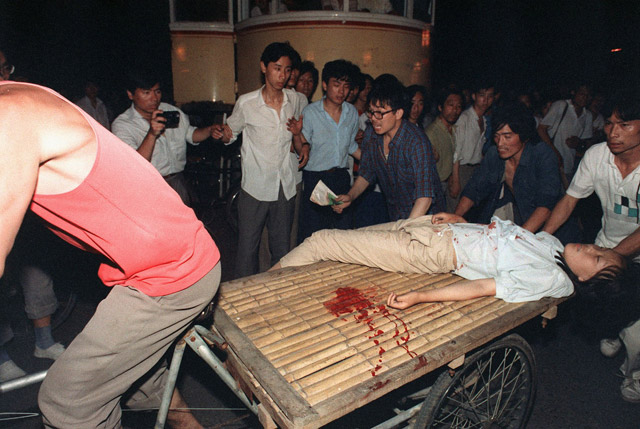
A girl wounded during the clash between the army and students on June 4, 1989 near Beijing's Tiananmen Square is carried out by a cart. (Manuel Ceneta/AFP/Getty Images)
This Wednesday marks the 25th anniversary of the deadly suppression of the 1989 Tiananmen protests on June 4. That day and its aftermath continue to haunt China today, and on ChinaFile we have been exploring different dimensions of that legacy.
Alison Klayman, who directed the film Ai Weiwei: Never Sorry, produced this short film for us, in which a Chinese exchange student in Cairo and her Chinese-speaking Egyptian friend ponder the parallels between demonstrations in Beijing and Cairo. The Chinese woman, Yitong, says she only learned about June 4th after arriving in Egypt.
Hong Kong, is the one place in China where commemoration of the massacre is permitted. For the past several months ChinaFile has been collaborating with the University of Hong Kong’s Journalism and Media Studies Center and a team at The South China Morning Post on the production of a multimedia reconstruction of the spring of 1989. The Post published the resulting “Voices From Tiananmen” last night — my short introduction is here. In addition to an impressive piecing together of photography, video and archival sources, “Voices from Tiananmen” includes new video interviews with several key figures (including Mao Zedong’s former secretary, Li Rui and Bao Tong, the most senior party official to be jailed for opposing the crackdown) recounting their personal experiences and reflecting on the massacre’s significance for Chinese politics and for ordinary Chinese people.
In large part thanks to our partnership with The New York Review of Books, ChinaFile has a substantial archive of writing on June 4th, both historical and contemporary. We have collected some of the best in this compendium of resources. In particular, I urge you to spend time on this essay, by civil rights lawyer Pu Zhiqiang, which describes the way he tried to commemorate his days as a student activist in 1989, while in policy custody several years ago. This year, a month ahead of the anniversary, Pu and four friends were detained after holding a private commemoration in a Beijing apartment, for which Pu was charged with “creating a disturbance in a public place.” Also don’t miss our excerpt of NPR correspondent Louisa Lim’s new book, People’s Republic of Amnesia: Tiananmen Revisited; our recent ChinaFile Conversation on whether China can move past Tiananmen; Orville Schell’s firsthand reporting from Beijing in the spring of 1989 and Perry Link’s recent essays “The Specter of June 4th” and “Detained to Death.”
Several other stories are now in the works and I encourage you to check ChinaFile over the next couple of days for updates.
Fuente: Asia Sociaty

jueves, 29 de mayo de 2014

Centro Cultural e Informativo de la Embajada de Japón

·         Shiro “El Arriero”
Recital de Guitarra “Iberoamericana”

El martes 10 a las 19:30 hs., Shiro Otake ofrecerá un recital de guitarra en el Auditorio de la Universidad del CEMA, Reconquista 775, CABA.
Tendrá como invitado especial al Coro de Nichia Gakuin. La entrada es libre y gratuita hasta completar capacidad.
Informes: (011) 4318-8240, centro-info@bn.mofa.go.jp
Organiza: Centro Cultural e Informativo de la Embajada del Japón, Fundación Japón y UCEMA

·         Shokufutei Kakushow
Conferencia y demostración de Rakugo
“El humor es un lenguaje universal”


El miércoles 18 a las 19:00 hs., se realizará una conferencia y demostración de Rakugo (monólogos japoneses) a cargo de Shofukutei Kakushow en el Centro Okinawense en la Argentina (COA), Av. San Juan 2655, CABA.
La entrada general será de un bono contribución de $15 (mayores de 65 años y menores de 12, sin cargo).
Informes: (011) 4318-8240, centro-info@bn.mofa.go.jp
Organiza: Centro Cultural e Informativo de la Embajada del Japón, Fundación Japón, Federación de Asociaciones Nikkei en la Argentina (FANA) y COA

·         Equipo Nacional de Vóley Masculino del Japón
Liga Mundial FIVB 2014

Japón integra el Grupo D junto a Argentina, Alemania y Francia, y su calendario de competencia prevé los siguientes partidos:
Argentina vs. Japón
Vie. 6 de junio, 22:00hs., y
Dom. 8 de junio, 21:00hs.
Lugar: Microestadio de Lomas de Zamora (Parque Eva Perón, Lomas de Zamora, Buenos Aires – Av. Juan XXIII, continuación Molina Arrotea entre Las Lilas y Los Robles -)
Organiza: Federación Internacional de Volleyball (FIVB) y Federación de Voleibol de Argentina (FeVA)

Saludos Cordiales.

Noemí Murakami
Embajada del Japón en la República Argentina
Bouchard 547, Piso 15, C1106ABG, C.A.B.A.
lu-vie 9:00-12:30 y 14:30-17:00 
Tel: (+54 11) 4318-8240